HPTN 052
A Randomized Trial to Evaluate the Effectiveness of Antiretroviral Therapy Plus HIV Primary Care versus HIV Primary Care Alone to Prevent the Sexual Transmission of HIV-1 in Serodiscordant Couples

- Study Summary
- Details
- Documents
- Personnel
- Sites
- Publications
What was HPTN 052?
A Phase III, two-arm, randomized, controlled, multi-center trial to determine whether antiretroviral therapy (ART) can prevent the sexual transmission of HIV-1 in HIV-1 serodiscordant couples.
Who participated in the study?
HPTN 052 enrolled 1,763 HIV sero-discordant couples – where one person is HIV-infected and the other is not – at 13 sites in nine countries. The majority of the couples were heterosexual (97%).
What happened during the study?
HIV-infected partners were assigned to start ART at the beginning of the study, called the “early” arm (CD4 count at ART initiation 350-550 cells/mm3), or later in the study, called the “delayed” arm (CD4 count at ART initiation 350-550 cells/mm3). Those on the delayed arm started ART when their bodies’ immune systems were declining.
Results
In 2011, an interim review of the study data showed a 96% reduction of HIV transmission within the couples assigned to early ART, which was considered a major breakthrough finding. After the release of the results, all participants in the delayed ART arm were offered the opportunity to begin ART, and the study continued for four more years. By the end of the study, 1,171 couples remained in follow-up.
As reported at IAS 2015, the final results showed a 93% reduction of HIV transmission within couples when comparing the group in which the HIV-infected partner was assigned to early ART with the group in which the HIV-infected partners was assigned to the delayed ART group. Notably, there were only eight cases of HIV transmission within couples after the HIV-infected partner was given ART. Four of these eight cases were diagnosed soon after ART initiation and transmission likely occurred before the HIV-infected partner was virally suppressed. The other four were diagnosed when the HIV-infected partner had detectable levels of virus in the blood despite being on ART (i.e., treatment failure).
Treatment failure may have occurred because participants either did not take their antiretroviral drugs as prescribed or had an HIV strain that resisted or acquired resistance to one or more of the drugs in their treatment regimen.
In the HPTN 052 study, HIV transmission from HIV-infected study participants to their partners was not observed when viral replication in the treated individual was stably suppressed by ART.
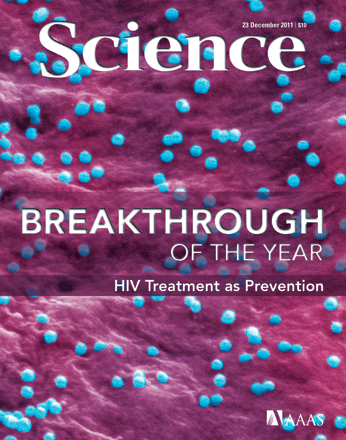
In 2011, Science named HPTN 052 its "Breakthrough of the Year."
Why was this study important?
This was a landmark study proving that early ART can prevent HIV transmission.
Following the interim results of the HPTN 052 study, the World Health Organization recommended that antiretroviral treatment be offered to all people living with HIV who have uninfected partners to reduce HIV transmission in 2013.
“These findings demonstrate antiretroviral therapy, when taken until viral suppression is achieved and sustained, is a highly effective, durable intervention for HIV prevention”
said Myron Cohen, M.D., Director of the Institute for Global Health and Infectious Diseases at the University of North Carolina at Chapel Hill and Principal Investigator for HPTN 052.
Protocol Status
Concluded
Study Purpose
The purpose of this study is to determine whether antiretroviral therapy (ART) can prevent the sexual transmission of HIV-1 in HIV-1 serodiscordant couples.
Study Design
The study is a Phase III, two-arm, randomized, controlled, multi-center trial.
Study Population
HIV serodiscordant couples in which the HIV-infected partner is ART naïve and has a CD4+ cell count of 350-550 cells/mm^3.
Study Size
Approximately 1750 couples total.
Study Duration
Approximately 78 months total. Accrual will require approximately 18 months total, and all couples will be followed until the last couple enrolled completes their 60-month follow-up visit.
Treatment Regime
HIV-infected index cases will be assigned at random in a 1:1 ratio to one of two treatment arms: ARM 1: ART upon enrollment plus HIV primary care. ARM 2: HIV primary care without initiation of ART until the participant has two consecutive measurements of a CD4+ cell count within or below the range of 200-250 cells/mm^3, or develops an AIDS-defining illness. The ART drugs available for the study are Combivir [3TC/ZDV], ATV, EFV, NVP, TDF, 3TC, ddI-EC, d4T, Kaletra/Aluvia [LPV/r], and Truvada [FTC/TDF].
Primary Objectives
The primary objective of the study is to compare the rates of HIV infection among partners of HIV-infected participants in the two study arms below:
(1) Antiretroviral therapy upon enrollment plus HIV primary care.
(2) HIV primary care, without initiation of antiretroviral therapy until the participant has two consecutive measurements of a CD4+ cell count within or below the range of 200-250 cells/mm^3, or develops an AIDS-defining illness.
Secondary Objectives
To determine the long-term safety of two ART regimen strategies (ART immediately upon enrollment vs, ART when the participant has two consecutive measurements of a CD4+ cell count within or below the range of 200-250 cells/mm^3 or develops an AIDS-defining illness) for the treatment of HIV-1 infection.
To characterize and compare the patterns and rates of antiretroviral drug resistance of two antiretroviral treatment strategies.
To assess factors associated with and to compare adherence of two antiretroviral treatment strategies.
To evaluate the usefulness of measures of virologic and immunologic efficacy, and measures to detect antiretroviral drug resistance.
To determine, characterize, and compare the rates of AIDS-defining and HIV-related illnesses, sexually transmitted diseases, opportunistic infections, immune reconstitution syndromes, and other targeted medical conditions, with regard to outcomes and survival as observed in different geographic settings and by antiretroviral treatment strategies.
To determine and characterize the rates of antiretroviral drug-associated toxicities observed in different geographic settings and by treatment strategies.
To evaluate the effectiveness of couples HIV counseling and characterize the patterns of
sexual behavior in couples in both arms of the study. To characterize and compare Quality of Life (QOL) indicators in different geographic settings and by antiretroviral treatment strategies.
To determine, characterize and compare the effect of circumcision on HIV transmission in different geographic settings and by antiretroviral treatment strategies.
Other Objectives
Study Documents
HPTN 052 Version 3.0
- HPTN 052 V 3.0
- Summary of Changes V2.0 - V3.0
- HPTN 052 V 3.0, LoA #5, 10 May 2011
- HPTN 052 V 3.0, LoA #4, 9 Dec 2008
- HPTN 052 V 3.0, LoA #3, 30 Jul 2008
- HPTN 052 V 3.0, LoA #2, 20 March 2008
- HPTN 052 V 3.0, LoA #1, 7 August 2007
- HPTN 052 V 3.0 CM #3, 07 Nov 2013
- HPTN 052 V 3.0 CM #2, 31 Aug 2011
- HPTN 052 V 3.0 CM #1, 26 Aug 2009
HPTN 052 Version 2.0
- HPTN 052 V 2.0
- Summary of Changes V1.0 - V2.0
- HPTN 052 V 2.0, LoA #2, 13 July 2005
- HPTN 052 V 2.0, LoA #1, 23 December 2004
- HPTN 052 V 2.0 CM #2, 24 Dec 2004
- HPTN 052 V 2.0 CM #1, 24 Sept 2004
HPTN 052 Version 1.0
Presentations
- AIDS 2012: Poster, Y.Q. Chen
- AIDS 2012: Presentation, R. Freedberg
- AIDS 2012: Presentation, B. Grinsztejn
- AIDS 2012: Poster, K. Mayer
- AIDS 2012: Oral Poster Presentation, K. Mayer
- AIDS 2011: Presentation, M. Cohen
- AIDS 2011: Presentation, S. Eshleman
- AIDS 2011: Presentation, M. Hosseinipour
- AIDS 2011: Presentation, B. Grinsztejn
- AIDS 2011: Presentation, M. Cohen
Press
- Press Release: HPTN 052 HIV Prevention Study Demonstrates Sustained Benefit of Early Antiretroviral Therapy - July 2015
- HPTN 052 Q & A - Preventing Sexual Transmission of HIV with Anti-HIV Drugs
- Press Release: Study Finds Early Initiation of ART Leads to 96% Reduction in HIV Transmission
- Press Release: Expanded Analysis of HPTN 052 Study Results Reveal Additional Benefits of Early HIV Treatment
- Press Release: Expanded Analysis of HPTN 052 Study Results Show Cost-Effectiveness of Early Treatment of HIV
- Fact Sheet: Initiation of Antiretroviral Therapy (ART) Prevents Sexual Transmission of HIV in Serodiscordant Couples

David Celentano
Protocol Co-Chair
Suwat Chariyalertsak
Protocol Co-Chair
Myron Scott Cohen
Protocol Chair
Leslie Cottle
SDMC Protocol Specialist
Theresa Gamble
CORE Protocol Specialist
Beatriz Grinsztejn
Protocol Co-Chair
James Gita Hakim
Protocol Co-Chair
Irving F. Hoffman
Protocol Co-Chair
Mina Christine Hosseinipour
Protocol Co-Chair
Andrea Jennings
CORE Protocol Specialist
Nagalingeshwaran Kumarasamy
Protocol Co-Chair
Johnstone Kumwenda
Protocol Co-Chair
Kenneth H. Mayer
Protocol Co-Chair
Marybeth McCauley
CORE Protocol Specialist
Karin Alvarenga-Hyldgaard Nielsen
Protocol Co-Chair
Breno Riegel Santos
Protocol Co-Chair
Taha Taha
Protocol Co-Chair